
1 Oct 2018
683

Born in Ibiza in 1888 from a Galician father and an Ibicenco mother, and the youngest of 8 brothers, Joan Gómez Ripoll was better known as “Campos”. He passed away in Palma in 1942. After his secondary studies, he started to work as a stonemason at the age of 16, first in Ibiza and then in Palma, where he was considered as a first-class tradesperson. He also continued his own studies in drawing and sculpture at the School of Arts and Trades. He started reading works with social content by authors like Marx, Proudhon and Kroptkin, who provided him with a profoundly social sense of existence. He came back to Ibiza to fulfill his military service and, when he finished it, he officially became a master builder. He married in 1917 and had two daughters. In 1920 he emigrated to Cuba, where he continued working his trade throughout the nine years he lived there. He even built himself a house with the intention of taking his family out there, but it was destroyed. In 1929 he returned to Ibiza and had a third daughter. He signed up to the Spanish Workers' Party in 1932. In July 1936 he was incarcerated in the castle and a month later was freed by the Republicans. For the five weeks that the Republicans were in power, he was the delegate for employment, industry and public works but, when the Republicans abandoned the island, he moved with his family to Valencia and Castellón until the war was over, when he returned to Ibiza. However, on 21st April 1939 he was detained and taken to Palma. He was accused of melting down the bells from the churches and of ordering the demolition of Sant Elm's church, amongst other accusations. Although he showed good conduct and had not committed any violent crimes, he was condemned to death and executed in front of Palma's cemetery wall in September 1942.
En 2001, the Consell of Ibiza and Formentera installed a plaque to commemorate him on the house where he was born, in Josep Verdera Street.
But why are we mentioning Campos? Because his architectural work is the most important and coherent carried out on the island in the first part of the 20th century. This was a time when self-taught master builders outdid their own architects.
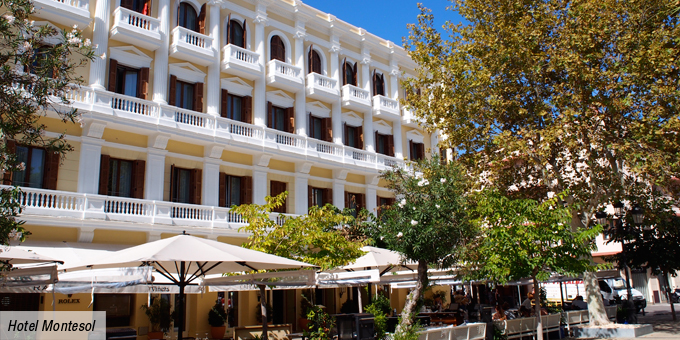
In 1917 he carried out his first assignment: a mausoleum in the old cementery of Ibiza. In Cuba he then came into contact with colonial architecture, which became integral to his work after that. Back in Ibiza, he set up his own construction company. A country house in Sant Joan in 1930 was the first of ever-more important assignments, coinciding with the expansion of the city of Ibiza with new peripheral housing developments. He created the gallery of a building at number 2, Bisbe Torres Street, or the building known as Casa Vilàs, between Bisbe Azara and Bisbe Cardona streets, or the building at 13, Madrid Street. And most notably, in 1933, his most symbolic and famous piece: The Gran Hotel, aftewards called Hotel Montesol, in Vara de Rey. A plaque at the entrance mentions him. He trained workers and exchanged drawings, sometimes leading to mistakes in the documenting of his works. His legacy has been declared a protected cultural heritage site (BIC).
En 2001, the Consell of Ibiza and Formentera installed a plaque to commemorate him on the house where he was born, in Josep Verdera Street.
But why are we mentioning Campos? Because his architectural work is the most important and coherent carried out on the island in the first part of the 20th century. This was a time when self-taught master builders outdid their own architects.
Looking for a property in Ibiza or Formentera?
Let our AI assistant help you find your perfect property in Ibiza
Suggested Articles
1
 2
3
4
5
6
2
3
4
5
6
Ibiza Optimista
Sponge Cities
December 2025 – February 2026
·1938 views
Ibiza Optimista
Possible Alternative to LASIK Eye Surgery
December 2025 – February 2026
·1600 views
Ibiza Optimista
Cleaning Lakes Ecologically
December 2025 – February 2026
·1574 views
Ibiza Optimista
Bridge to Connect Sicily and Mainland Italy
December 2025 – February 2026
·1542 views
Ibiza Optimista
Our Cells Can Listen
December 2025 – February 2026
·1444 views
Ibiza Optimista
Ibiza’s Farmers Celebrate the Rains
December 2025 – February 2026
·1444 views