This website uses our own cookies to collect information in order to improve our services, and to analyse users’ browsing habits. Your continued use of this website constitutes acceptance of the installation of these cookies. The user has the option of configuring their browser in order to prevent cookies from being installed on their hard drive, although they must keep in mind that doing so may cause difficulties in their use of the webpage.
Ibiza’s History - Part VIII: Crusades and Conquests
By Emily Kaufman
Ibiza’s History - Part VIII: Crusades and Conquests
By Emily Kaufman
15 Jun 2019
1619
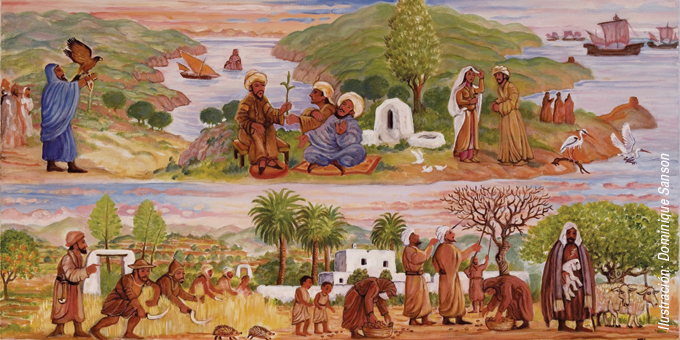
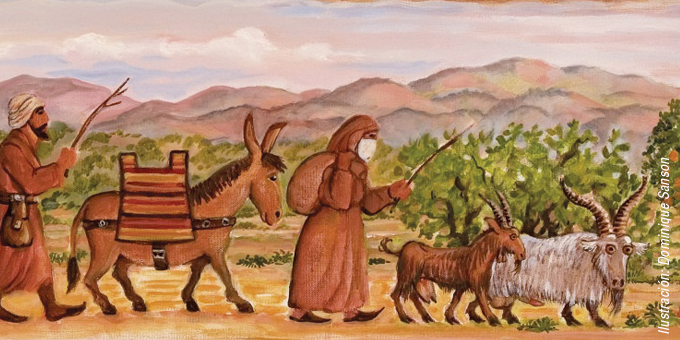
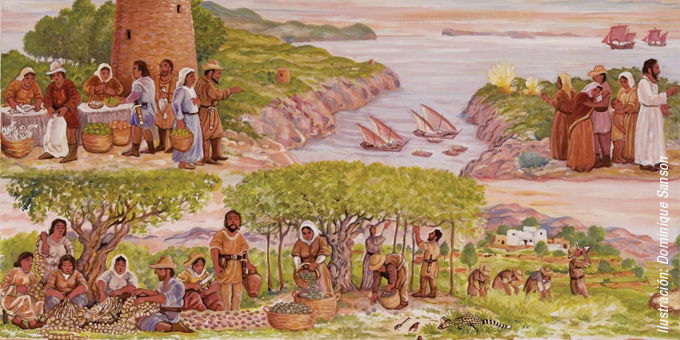
Moorish culture in Spain under the Caliphate of Cordoba reached its remarkable zenith in the 10th century drawing praise even from its rivals for its incredible achievements. Ibiza, as part of that realm, attained levels of civic, commercial and agricultural prosperity greater than at any time since the fall of Rome. In fact, the Moorish influence lifted the whole of the Iberian Peninsula out of post-Roman stagnation long before the rest of Europe followed suit. Cordoba, in effect, was the new Rome and Ibiza basked in her glow.
But, these halcyon days were cut short by ruinous infighting in the early 11th century. Over the course of a 22-year civil war, the caliphate splintered into a patchwork of petty states (known as “taifas”), each vying for supremacy under its own regional king. In 1014, Ibiza, along with the other Balearics, was violently seized by the Taifa of Denia, one of the most powerful of these states thanks to its well-developed naval and commercial ports. The islands’ taifa years were characterized by despotic rule under the tyrant Mujahid, known to history by his Latin name, Mugettus Rex.
Ibiza prospered under the Moorish Caliphate
His governance is remembered as cruel and exacting, especially in contrast to the economic climate that had been so favourable during the Caliphate. Domestically, he clamped down on free trade, created state-run monopolies and implemented iron-fisted fiscal policies that practically amounted to extortion. In foreign policy, he established piracy as the primary means of “diplomacy”. He skilfully used the Balearics as a staging ground for naval assaults against the Christian trade circuits that were beginning to flourish in the northern Mediterranean.
Muggetus died in 1045, and his death brought a brief period of renewed tolerance. The new king, his son Ali, proved to be as mild and benevolent as his father had been fierce and autocratic. Indeed, it was none other than King Ali who engaged Ibiza’s very own Al-Sabbini to be poet laureate at his court in Denia. Unfortunately, Ali died young when he was betrayed by his venal father-in-law, who usurped mainland Denia, but did not take the further step of capturing the islands.
At this juncture, 1059, the Balearics entered a period of self-government that lasted just over half a century. The reigning wali, Mubasir, declared himself king and carried on business as usual, minting his own coins and continuing to engage in the rampant piracy which, since Muggetus’ reign, had become habitual. Yet, for an isolated island kingdom to maintain its independence in an increasingly conflicted seascape was problematic. Several new powers had emerged in the Mediterranean, and were competing for dominance- chiefly, the Christians to the north and the Berbers to the south. Victims of their own disunity, the Hispanic Moors could no longer keep these encroaching powers at bay.
The Christians had long viewed the islanders as pests who disrupted the conduct of maritime trade. In particular, the busy shipping lanes linking the rising cities of Barcelona, Genoa, Marseilles and Pisa were regularly sabotaged by Balearic piracy. Angered by these assaults, the Pisans decided to strike back, enlisting the aid of Barcelona to the cause. The joint expedition, known fittingly as the Pisan-Catalan Crusade, was sanctioned in 1113 by Pope Paschal II and enjoyed additional naval support from Italy, Provence, Sardinia and Corsica.
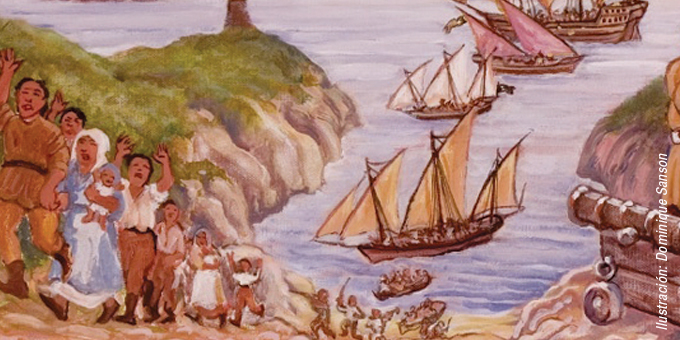
Christian Crusades against Moorish Ibiza
The campaign was undertaken in two stages. First, a reconnaissance tour sailed to Ibiza to assess the situation and quickly realized that its walls could not be breached without a serious war effort. The invaders merely raided the countryside and went back home, looting randomly in Mallorca and Menorca as they passed. The second stage of the crusade was launched in earnest by the dual desires to eradicate Balearic piracy and free the many Christian captives held in Moorish dungeons. Again, Ibiza was targeted first, with a fleet of 500 ships converging on the island in June of 1114. After a bitter seven week siege the citadel surrendered - but not without a fight. Ibiza’s wali, (leader) Abu al-Mundir, a former Christian converted to Islam, gave his life defending his turf in fierce hand-to-hand combat. The crusaders wasted no time in freeing the Christian captives and demolishing the city’s fortifications. That done, they set off for Mallorca which was their primary objective. An eight-month siege at Palma eventually forced capitulation by the Moorish defenders. After freeing the Christian captives, laying the island to waste, enslaving its entire population and dividing up the booty, the crusaders simply withdrew… which again left the islands in a state of temporary non-governance. This left the door open for the Almoravids - an ascendant Berber clan newly governing in Al-Andalus. In 1116 they assembled an armed fleet that sailed into Palma’s desolate harbour and undertook the labour of rebuilding Mallorca and the other Balearics. Ibiza remained under Almoravid rule until 1188 when it fell without a fight to the Almohades, a new Berber power that had arisen. This unremarkable phase of statehood would constitute the last dying ember of Ibiza’s 333 years of Moorish rule.
As the 13th century opened another change for Ibiza was brewing on the horizon – and this one would prove to be both seminal and enduring.
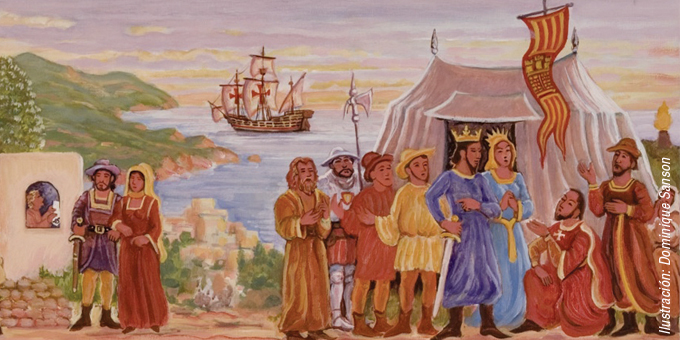
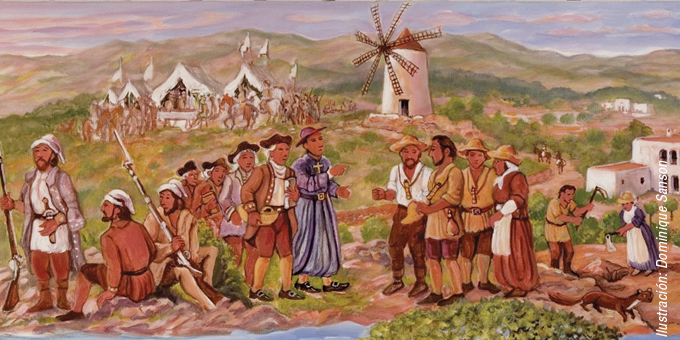
The Catalans were busily preparing another crusade under the leadership of their intrepid new king James I the Conqueror (1208-1276). As part of the larger “Reconquista”, James conquered Mallorca in1229, but had to postpone the capture of Ibiza for a number of reasons, among them a parallel campaign to take Valencia. Six years passed and the king was still occupied with other theatres of war. James finally made the decision to delegate the Ibiza campaign to Guillem de Montgrí, one of his trusted warlords. Montgri was a wealthy nobleman with significant resources of men and ships at his disposal, but he calculated that he would need to double his manpower in order to take Ibiza. His solution was to propose a joint initiative with two prominent knights - Peter of Portugal and Nuño Sanz, both scions of royal lineage. A pact was made and, on 8 August, 1235 the combined fleets sailed into Ibiza’s port. Victory was swift and it ushered in a wholly new chapter in the island’s history. At the time this may have seemed like a minor medieval incursion that was not fated to last, given Ibiza’s history of numerous masters. Yet the Catalan Conquest implanted a culture in Ibiza that has endured to the present day. Nearly eight centuries later Catalan remains the official language, and our culture is tied to the Catalan mainland. These ties also run deeply on the genetic level as the DNA of local islanders features an exclusively Catalan genome.
Looking for a property in Ibiza or Formentera?
Let our AI assistant help you find your perfect property in Ibiza


 2
2