
15 Jun 2018
1925

The gods of Antiquity thundered out from the heavens, brandishing lightning bolts and defeating all foes... or so the mythological cliché goes. In fact, the ancient world view encompassed a remarkable scope of masculine archetypes. The attributes they ascribed to their male deities ranged from the fierce and bellicose to the mild and holy. Using Ibiza’s pantheon as a case in point, let us explore this rich diversity as it was expressed by the five male divinities worshipped in Phoenicio-Punic times.
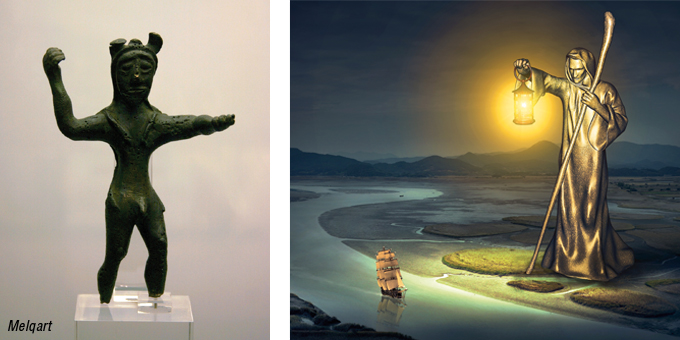
High on the list is Melqart, top god of the Phoenician city-state of Tyre and consort to Astarte. Together, this pair comprised a dual godhead that functioned in tandem, each looking after his or her areas of protection. Over the centuries, as the needs of society changed, these areas of protection changed as well. Melqart literally means “lord of the city” and his primary function was to safeguard the common good, but that might have been perceived differently at different stages of history. For example, when Tyre was an emerging coastal city in the third millennium BCE (over 4,000 years ago), striving to sustain itself on a thin strip of land, Melqart was envisioned as an agrarian god - guardian of the harvest and overseer of the ongoing cycle of life, death and rebirth. He was associated with winter wheat and barley - the staple crops necessary for the survival of the population. But, as Tyre developed into a sophisticated, prosperous city with a far-flung trade network, Melqart’s domain shifted from the land to the sea, and his area of custodianship passed from agriculture to seafaring and commerce. He is credited with discovering the process by which murex seashells yield a rare purple dye, which was one of Tyre’s unique exports.
High on the list is Melqart, top god of the Phoenician city-state of Tyre and consort to Astarte. Together, this pair comprised a dual godhead that functioned in tandem, each looking after his or her areas of protection. Over the centuries, as the needs of society changed, these areas of protection changed as well. Melqart literally means “lord of the city” and his primary function was to safeguard the common good, but that might have been perceived differently at different stages of history. For example, when Tyre was an emerging coastal city in the third millennium BCE (over 4,000 years ago), striving to sustain itself on a thin strip of land, Melqart was envisioned as an agrarian god - guardian of the harvest and overseer of the ongoing cycle of life, death and rebirth. He was associated with winter wheat and barley - the staple crops necessary for the survival of the population. But, as Tyre developed into a sophisticated, prosperous city with a far-flung trade network, Melqart’s domain shifted from the land to the sea, and his area of custodianship passed from agriculture to seafaring and commerce. He is credited with discovering the process by which murex seashells yield a rare purple dye, which was one of Tyre’s unique exports.
Another important Phoenician god whose cult flourished in Ibiza was Eshmun, the god of healing. He was to Sidon (another Phoenician city-state) what Melqart was to Tyre: the city’s top god. The Greeks equated him with Asclepius, son of Apollo, both gods of healing. While the archaeological record is silent as to his cult in Ibiza, two indirect clues speak of a strong presence. Our first indication rests on the prevalence in Punic Ibiza of the surname Abd’eshmun, meaning “servant of Eshmun”. Across the ancient world, theonyms, or surnames derived from the gods, were quite common. When a victorious culture supplanted a vanquished one, locals often tried to conform to the new ruling class by changing their surnames. So it happened that, following Rome’s victory over Carthage, Ibiza was found to have an unusually high incidence of the surname Apollonius, derived from Eshmun’s homologue, Apollo. Epigraphists have interpreted this as a wholesale Latinization of the Punic surname Abd’eshmun in an attempt to curry favour with Roman bureaucrats. A second testimony to Eshmun’s cult in Ibiza was discovered in Murcia in the form of a Latin inscription: sacerdos Asculepi Ebusitani. This means “Ibicenco priest of Asclepius”, and seems to be a reference to Eshmun’s healing order on the island. Interestingly, the Romans equated Eshmun with Mercury, whose symbol was the caduceus with two serpents intertwined. Today it is an emblem of the medical profession, but in his Phoenician form, Eshmun was represented by just a single snake.

Our next god is Bes, Ibiza’s namesake. This fun-loving deity was a party animal, whose two main characteristics were his ability to drive away snakes and other poisonous creatures, and his love of dance. Adopted by the Phoenicians from Egypt, he was envisaged as more of a secondary god or benevolent spirit. The epigraphist Solà Solé theorized that Ibiza’s first Phoenician settlers must have been impressed by the island’s absence of venomous animals, and attributed this charmed state of affairs to Bes’ divine protection, naming the island after him. Virtually all coins of early Ibicenco mint carried an image of Bes, pot-bellied, bow-legged and wielding a snake in his hand. This peculiar portrayal correlates to the fact that Bes originated in sub-Saharan Africa, where the Pygmies (whose morphology Bes replicates) were famed for performing the “Dance of God”, hence his association with singing, dancing and revelry.
Looking for a property in Ibiza or Formentera?
Let our AI assistant help you find your perfect property in Ibiza
Suggested Articles
1
 2
3
4
5
6
2
3
4
5
6
Inside Ibiza
PEOPLE OF IBIZA An Island of Artistic Creation
December 2025 – February 2026
·2057 views
Inside Ibiza
Andrés Coll The Magic of Marimba
October - December 2025
·1328 views
Inside Ibiza
TANIT The Eternal Goddess of Ibiza
August - October 2025
·1607 views
Inside Ibiza
JAZZ POINT IBIZA 2025 International Jazz Excellence
August - October 2025
·1411 views
Inside Ibiza
L’ATELIER 303 - The Ultimate Ibiza Experience
August - October 2025
·1313 views
Inside Ibiza
Gypsy Westwood - Seeing Life Through the Lens
June - August 2025
·1293 views